


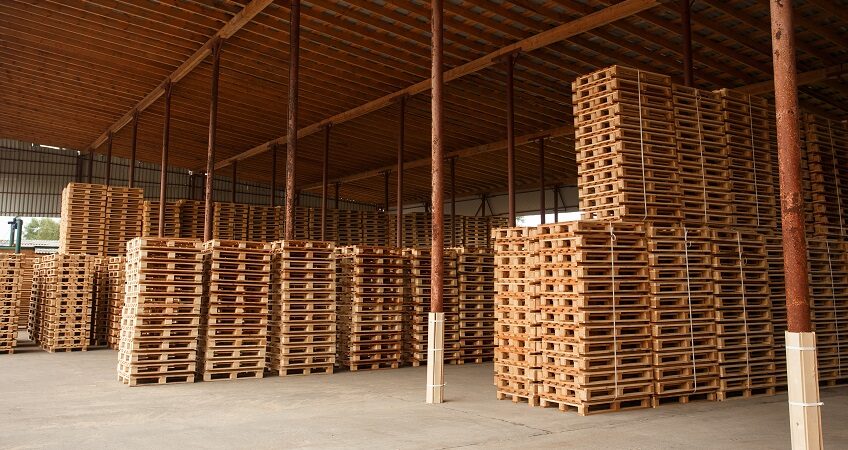
Pallets or pallets are wooden containers of rectangular or square shape, made of flat wooden boards, which are used as a basis for creating a single goods place, which allows the transportation of goods without worrying about their safety.
The choice of a particular pallet size and type depends on a variety of factors, including the requirements of a particular business, the characteristics of the goods and the specifics of transportation.
Many companies may prefer to use standard pallet sizes as they provide compatibility with a wide range of equipment, including hoists and racking. However, in certain cases, smaller pallets may be preferred due to limited warehouse space or transportation requirements. For example, pallets with dimensions of 800×600 mm may be convenient for transporting small goods or for use in confined spaces such as urban warehouses or stores.
In summary, choosing the size and type of wooden pallet is an important decision for companies in the logistics and warehousing industry. It should be based on the specific needs of the business, industry requirements and optimization of logistics processes.
For example, in the case of using pallets as containers for air freight and for storage and transportation to stores and retail outlets, it is worth looking at the weight, length, width, load capacity, etc. restrictions in each case. It is also necessary to provide for convenient storage to organize the storage of pallets in conditions of optimal humidity when planning the future use of the pallets. It is recommended to store pallets in stacks to minimize damage and save storage space.

Pallets are used for both domestic and international transportation. International transportation of goods on wooden decks (pallets) has its own peculiarities. A thorough phytosanitary control is mandatory.
The material from which the pallets are made also matters, the type of wood affects the strength and load capacity. It is important to choose pallets made of quality materials to avoid breakage and damage during operation.
Manufacturing of pallets, as well as many other products, is subject to GOST and state standards. In Russia, these are two documents: GOST 9078-84 and GOST 9557-87.
The most popular on the market for many years remain Europallets (size 1200×800 mm), but many buyers also cooperate with Chinese production, which due to the large volume of production and cheaper raw materials can save on transportation pallets.
Apart from the standard sizes of wooden pallets 1200×800 mm and pallets 1200×1000 mm, there are other variants that are widely used in logistics and warehousing. For transportation of non-standard cargoes, pallets can be ordered according to individual dimensions.
Euro pallet size (EUR)
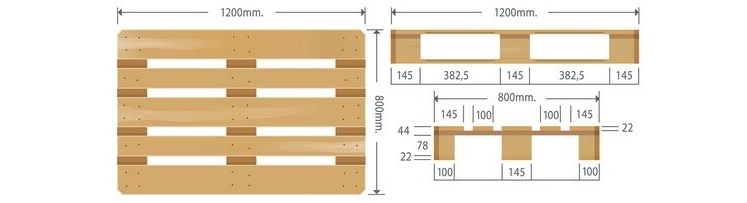
Europallets (EUR) correspond to dimensions 800x1200x145 mm. The europallet is branded EUR in an oval on the right vertical legs. The top of the euro pallet consists of five boards, arranged alternately: wide (145 mm), narrow (100 mm), and so on. The bottom part consists of three boards. The weight of the pallet itself is from 15 to 20 kg, load capacity up to 2.5 tons.

American Pallet Size (US)
The American pallet or pallet American is square-shaped with standard dimensions of 1200×1200 mm or 1000×1200 mm, height 145 mm, no stigma. They can be single or double decked, weigh from 15 to 40 kg and can support loads from 1000 to 1200 kg.
The lower part is made of three 100 mm chamfered boards, the upper part consists of seven boards of the same size. Single deck pallets have 7 boards at the top and 3 boards at the bottom, while double deck pallets have 7 boards at the top and 7 boards at the bottom. American pallets are more often chosen for domestic transportation across the country.
Finnish pallet size (FIN)
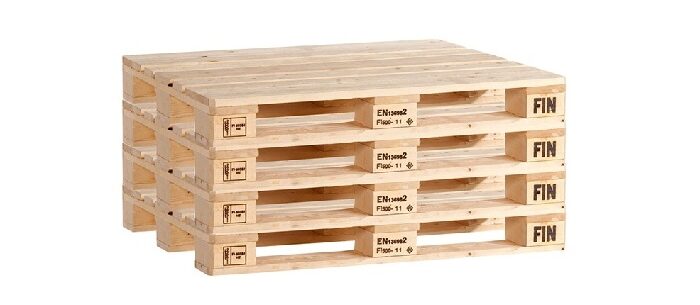
The Finnish pallet, or finpallet, corresponds to dimensions 1000x1200x145 mm. On the right legs of this type of pallet, there is a FIN branding engraved in a rectangle. On the center legs you can find information about the manufacturer and the date of production of the wooden container.
The upper part of the finpallet consists of seven boards: the first is 120 mm, followed by two boards of 100 mm each, and so on. On the underside there are two wide boards and one narrow board in the middle, with chamfered edges. The weight of finpallets varies from 15 to 20 kilograms. The load capacity is up to 1700 kilograms.
Dimensions of pallets for the domestic market
There is little to say about the utmost importance of pallet dimensions for the domestic market, as they must strictly comply with the standards and requirements established in this area.
In addition to certified euro and finpallets, reusable cargo pallets are also available on the market and can be categorized into the following types:
- Non-certified Europallets with dimensions 800x1200x145 mm, which fully correspond to the certified ones in terms of dimensions and construction, but have some distinctive features:
- Screw nails are used to assemble the pallets.
- The thickness of the board is 22 millimeters.
- No stigma.
- Pallets of the first grade with dimensions 800x1200x45 millimeters, by design europallets; however, their dimensions may vary slightly:
- Screw nails are used to assemble the pallets.
- Board thickness is 20 to 25 mm.
- The corners of the pallet are without chamfers.
- The distance between boards is no more than 50 mm.
- The wood is free of contaminants.
- Pallets of the second grade with dimensions 800x1200x145 mm, they are also made as Euro pallets and can be assembled using any nails. The pallets are without chamfers and the distance is 50 mm. These pallets may have minor soiling.
- Third grade pallets (dimensions 800x1200x145 mm) correspond to the dimensions 800×1200 mm, but otherwise their parameters may differ. The thickness of the board is from 15 to 25 mm, there are no chamfers, their assembly is performed using ordinary nails. These pallets may contain permissible contamination.
- Pallets with dimensions 1000x1200x145 mm are made in a similar way to finpallets, without chamfers and their assembly is carried out using any type of nails. Thickness from 15 to 25 mm.
Pallet varieties
Depending on the condition of the pallet, it is assigned a certain grade:
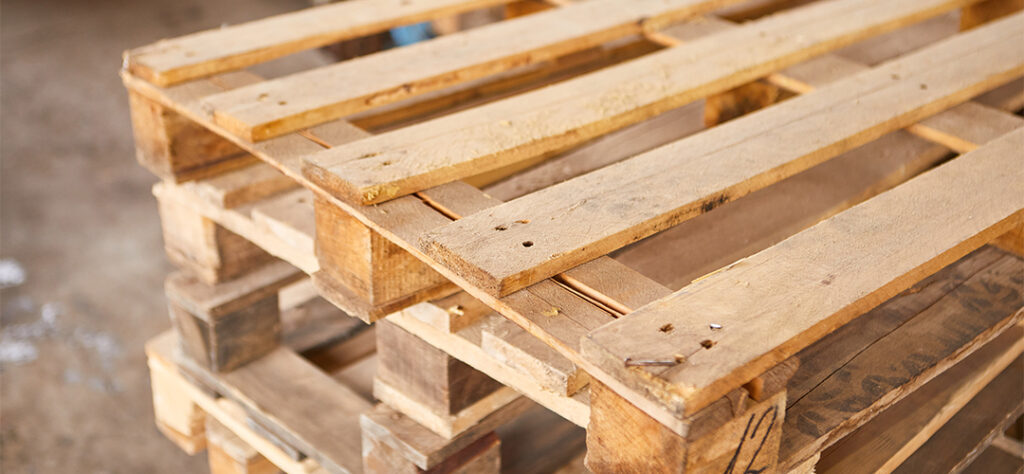
- 1 grade. A first grade pallet can be either a new product or a container that has been used no more than 3 times, but without any signs of use. The presence of dark stains on the container wood, chips, cracks and any other defects is not allowed.
- Grade 2 allows for minor surface damage. Such pallets can be used many times before and can be repaired. The connection of the legs to the deck can be made not only with screws, but also with construction nails. The second grade may be darker than the first grade, and the wood may be slightly stained.
- Grade 3 is a reusable container. In this case, the presence of defects on the wood is already acceptable: cracks (not more than 30 cm in length, 3 cm in width), chips and dirt.
Differentiation of pallets by loading method
There are two main types of containers according to the type of gripper:
- Double-entry pallets – the forked gripper can only be inserted from one of two opposite sides.
- Four-way pal lets – the pallet can be gripped from any of the four sides.
Pallet placement in the body
There are three main methods of loading pallets into the back of vehicles:
- Longitudinal method: in this case the pallets are placed horizontally, parallel to the transport platform.
- Transverse layout: Here the pallets are laid out widthwise, i.e. across the body.
- Combined method: with this method, the pallets are arranged in tiers, with the last row laid perpendicularly.
If you need to load pallets in several tiers, you can use stackers or forklifts.
For the transportation of goods and palletized goods, vehicles with covered bodies are preferred. However, open vehicles, trailers or semi-trailers can also be used for short distances.
If you need reliable and high-quality pallets, you can always turn to Ruspallet Group of Companies. We will find an individual solution for each client!