


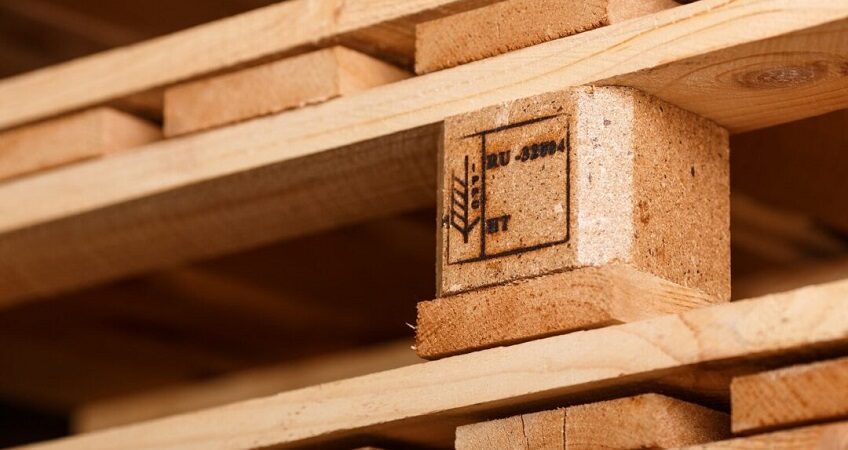
Wooden pallets are a convenient transportation container that ensures the safety of a large cargo unit. They are used all over the world, so there are strict standards that describe the requirements that these products must meet. Labeling of pallets is one of the mandatory conditions for their use in international trade.
Pallet labeling primarily has a promotional function. It represents information about the manufacturer and is applied with water-resistant dye or branding. If the pallets are made qualitatively and meet the highest standards, a good image is formed. Potential buyers in this case will pay attention to the manufacturer’s brand. In addition to the logo, contact information (phone number, e-mail address) is usually indicated. Labeling also helps to sort used products and keep records of containers.
In addition to information about the manufacturer, wooden containers may have specific designations adopted in the codes of standards of different regions of the world. For example, in Russia the requirements for pallet labeling are described in GOST 33757-2016.
How the markings are applied
The marking must be applied properly for it to perform its function:
- be prominent and clear,
- be resistant to external influences,
- contain all the necessary information,
- to meet the standards.
The markings are applied to the longitudinal sides of the pallet on both opposite sides. Stamping with a safe and durable ink, branding and engraving can be used.
Pallet labeling – phytosanitary inspection
Of particular importance is the branding on the pallets, which confirms that they have passed phytosanitary control. Since pallets are made of wood, there is a risk that they are infested with insect pests and plant pathogens. International trade in this case could become a transportation network for parasites, with serious environmental consequences.
Therefore, all containers used to ship goods abroad must undergo special treatment. Its methods are regulated by the ISPM 15 standard adopted in 2022. Essentially, there are two options: fumigation and heat treatment.
Fumigation (fumigation) is the treatment of wood by dispersing a poisonous gas or mist in a sealed environment. Methyl bromide is used as a poisonous agent. Before treatment, the dose and time interval of fumigation is calculated. For example, the minimum exposure time of wood in a poisonous atmosphere is 16 hours.
Since 2015, fumigation has been used less and less frequently, as containers treated in this way can be dangerous for the workers who come into contact with them. There is also a risk that the poisonous substance will penetrate into the cargo, which may be foodstuffs.
Heat treatment is increasingly taking the place of fumigation. It is carried out in special chambers where pallets are heated to a temperature of +56℃ and kept for 30 minutes according to a certain heating-cooling scheme. Other methods can also be used, but it is important that the result is equivalent to the heat treatment described above.
This is the case, for example, with chamber drying. Special chambers are used for heating, moistening, cooling and drying according to a specific technology. This process is easily automated, besides, it is not the packaging that is loaded into the chambers, but the lumber for its manufacture. Therefore, this method of processing is now used most often.
In accordance with the phytosanitary control standard, each batch of treated containers receives a certificate and a special IPPC label. It has a specific shape, for which it is also called “spike” or “herringbone”. It reflects the following information: the country code where the packaging was produced, the region of manufacture, the unique number of the organization that prepared the pallets and the method of decontamination.
- DB (debarking) – bark removal;
- HT (Heat Treatment) – Heat Treatment;
- KD (Kiln-dried) – chamber drying;
- MB (Methyl Bromide) – Methyl Bromide fumigation.
Euro pallet marking: EPAL and EUR stamps
In addition to the stamp of passing phytosanitary control, pallets arriving in Russia with cargo from European countries have other marks.
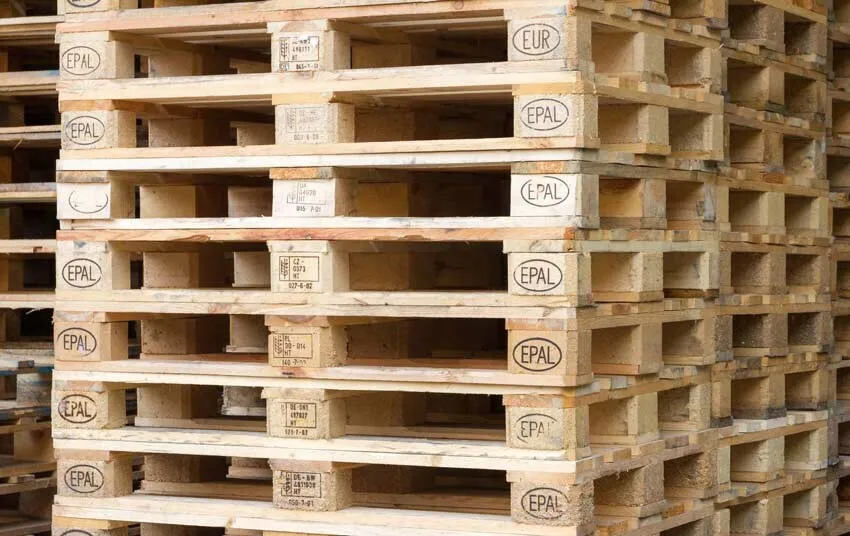
The EUR stamp in an oval frame indicates that the container is produced according to the European standard UIC 435-2. It was developed to simplify transportation in standard railway wagons, the speed of wagon loading with standardized pallets increased several times. Russia has a corresponding GOST, where the requirements for the dimensions and method of pallet manufacturing are very close to the European ones.
The label, with the letters EPAL in an oval frame, indicates that the pallet complies with the requirements of the European Pallet Association. It was founded in 1991 with the aim of preventing poor quality pallets from entering the market. EUR and EPAL logos can be used only by members of this organization, Russia is not among them.
Finpallet labeling
Otherwise, such pallets may be called FIN-pallet, Finnish pallet. Their main difference is their dimensions. They differ from the standard European and Russian ones. The dimensions of pallets according to domestic and European standards are 800×1200×145 mm, while those of FIN-pallets are 1000×1200×145 mm.
These pallets have special markings. The right support legs are marked with a stamp in the form of a lighted rectangle with the letters FIN inside. The middle support legs bear the date of manufacture and the manufacturer’s code.
Labeling of American pallets
New World pallets have their own standard sizes. They are the largest, square, 1200×1200×150 mm, otherwise they are called US-pallet, American. What distinguishes them is the absence of specific markings – there are no markings applied in one way or another. All information about their compliance with one or another standard is contained in the accompanying documents. For this, by the way, they are especially appreciated by those who like furniture from pallets – there is nothing that would spoil the appearance.
Ruspallet is one of the leading suppliers of europallets in Russia. We offer to buy pallets and europallets for various purposes wholesale and retail at a favorable price – we apply an individual approach to each customer. All our products are certified.