


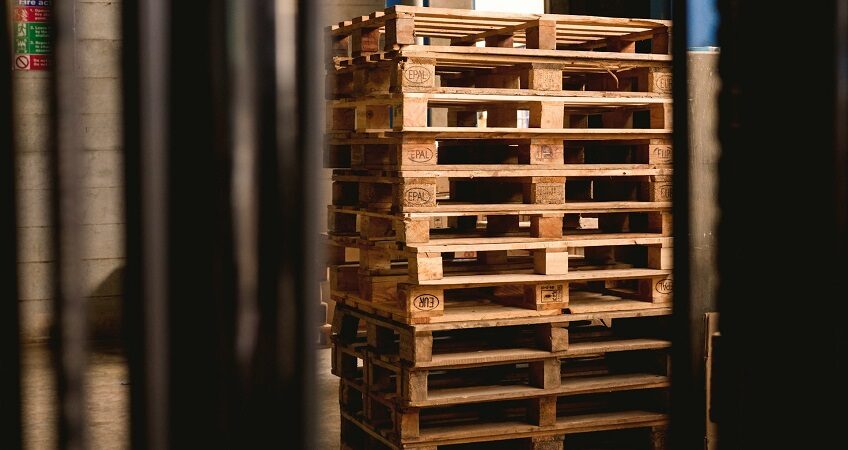
As a rule, trade and production activities imply the need to store wooden pallets – reusable transportation containers. Despite their seemingly primitive nature, many conditions must be met to ensure that they are well preserved. Safe transportation depends on the condition of the container, so it must be handled in a proper manner.
GOST requirements for pallet storage conditions
There is an official document that clearly regulates the requirements for transportation and storage of empty wooden pallets – this is GOST 33757-2016. In particular, it specifies the group of storage conditions according to the related document GOST 15150-69 – Zh2, and during transportation – Zh3.
Pallet storage locations and features
The standards stipulate the exact requirements for the storage of pallets (meaning empty wooden containers only):
- the storage room should be covered, the site should be flat, asphalted, suitable for unloading and loading equipment;
- pallets can be stacked in rectangular blocks of a maximum of 300 pieces each, the pallet storage height should not exceed 3 m and the stack vertical deviation should not exceed 50 mm;
- the distance from the warehouse wall to the pallet stack should be at least 40 cm, between two blocks – at least 2 m.
The storage room for wooden pallets must have a fire alarm system. If short-term storage is foreseen, pallets can be stacked in an open area and covered with waterproof material.
For the safety of the packaging, pallets of different designs (simple, with legs, box pallets) must not be stacked on top of each other, as they may be damaged. For the same purpose and to ensure safety, pallets should be stacked in such a way that the area of the bottom pallet is at least 40% larger than that of the top pallet.
Main ways of storing pallets in the warehouse
When storing pallets, it is important to comply with the requirements for pallet storage and to use the storage capacity efficiently. When talking about wooden containers, we are often talking about the most common types of pallets:
- Euro pallet (europallet), dimensions 1200×800 mm;
- typical pallet, the dimensions of which are the same as the europallet – 1200×800 mm;
- typical pallet with overall dimensions 1200×1000 mm.
It should be borne in mind that these are reusable containers, i.e. they can be new or used. Compliance with storage requirements is the key to long-lasting use of pallets.

The first way to store pallets is in stacks directly on the warehouse floor. However, such rooms often have rather high ceilings and the storage volume is not optimally utilized.
Large organizations often equip their premises with special equipment. If you install sturdy shelving in the warehouse, you will be able to accommodate many more pallets. However, it is important not to exceed the stack height requirement, and also take into account that the distance from the top pallet to the top floor cannot be less than 50 cm. Of course, such warehouses require specialized loading equipment.
Temperature and humidity control
In good conditions, wood retains its qualities for a long time, but it is not easy to ensure this. Wood products require constant temperature and humidity control in the storage room, and there are other challenges.
- Regular inspections and checks of used containers for parasites and mold are mandatory. Only after ensuring that the secondary pallets are completely safe can new pallets be placed next to them.
- Disinfection of wooden containers is not a one-time event, but a regular one. Even if there are no visible signs of infestation, disinfection should be carried out according to a specific schedule, which depends on the intensity of use of the pallets.
- Normal room humidity is the main concern of the person responsible for storing pallets in the warehouse. If the humidity is higher than the standard, the risk of wood-damaging fungi increases.
- For the safety of wooden containers it is desirable to install forced ventilation and a climate control system with a system of sensors that maintains the temperature and humidity in the room within acceptable limits.
- Often the cost of providing the right storage conditions is so great that it is easier and more cost-effective to sell used containers and then buy new used pallets or pallets when they are needed again.
Protection of pallets against moisture
Moisture is the main enemy of wooden products. Protecting against it is more important than the correct stacking of pallets in the warehouse. Mold destroys pallets and catastrophically reduces their service life. It is protected by drying according to a specific methodology.
The basic technology involves thoroughly drying the wood while it is still at the palletizing stage. The products assembled from such wood should then be stored in a proper manner to prevent them from increasing in moisture content.

Advanced technology allows the finished pallets to be dried using powerful fans. These fans reduce the moisture content of the wood to 20%, which is a natural barrier to the development of mold fungi.
In closed warehouses, special filters are installed to protect against fungal infestations, so that the air is free of spores. A healthy warehouse atmosphere is also promoted by the rapid turnover of containers, when they are not left in one place for long periods of time.
Long-term storage of pallets
If wooden pallets are to be stored for a long period of time, the first thing to do is to carefully inspect each unit of packaging. After that:
- Pallets that are too wet are dried;
- that are covered with mold, send them for disposal;
- in contact with the affected – treat with wood antiseptic;
- Damaged – checked for serviceability and repairability, serviceable ones are restored before storage.
If you have the need to keep new and used wooden pallets in storage for a long time, you need to weigh up the pros and cons. It may be easier and cheaper to sell the pallets and then buy them again when you need them.