


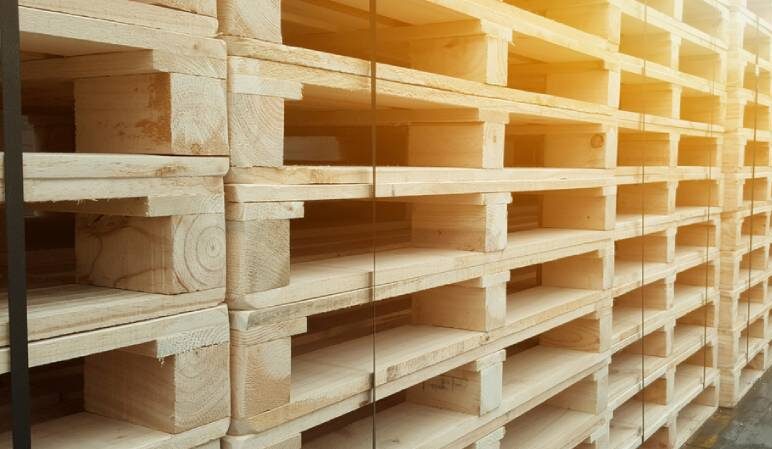
Wooden pallets are most often used when shipping goods for export. The wood from which the shipping containers are made can be infested with insect pests and pathogens of various diseases. Increased international trade facilitates the movement of alien parasites around the world, where they can become a major threat to local flora and fauna.
To prevent the spread of quarantine pests and pathogens, as well as contamination of the cargo, all transport packaging should be subjected to phytosanitary treatment. The rules of this treatment are regulated by the International Standard for the Regulation of Wood Packaging Materials in International Trade ISPM 15, adopted in 2002. Special markings help to visually identify a treated pallet. A shipment without a phytosanitary treatment certificate will not be able to pass customs procedures in most countries.
Methods of phytosanitary treatment of pallets
The international standard requires all wooden pallets to be debarked. There are two possible options for disinfecting containers.
- Heat treatment. Since 2015, the predominantly used method for general application. It is carried out in specialized chambers, where containers are heated to a temperature of +56℃ for 30 minutes according to a certain scheme. Instead of such treatment it is possible to use other methods of disinfection, provided that their result is equivalent to the described thermal treatment. In particular, a common method called “chamber drying”, in which heating, moistening, cooling and drying are performed alternately. This variant is gaining popularity, since it is not pallets that are put into special chambers, but lumber for their manufacture, and the whole processing can be automated
- Fumigation with methyl bromide in fixed doses at specific time intervals. For example, the minimum temperature at which fumigation is possible is +10℃ and the minimum exposure time is 16 hours.
Features and stages of pallet fumigation
Fumigation (fumigation) is the treatment of wood by dispersing a poisonous gas or fog. Disinfection with methyl bromide is carried out in a sealed environment.
First, the required concentration and quantity of the preparation are calculated according to the norms specified in the international standard. The prepared fumigant is sprayed and the room where the treated containers are located is saturated with gas. After holding for the calculated time, decontamination is carried out.
Labeling
Pallets that have undergone phytosanitary treatment are labeled. They are marked with an IPPC type stamp (“spike”) and the following information is entered on the stamp: country code of the producer, code of the region of manufacture, unique number of the organization that carried out the treatment and the method of disinfestation.
The latter characteristic is labeled as follows:
- HT (Heat Treatment) – Heat Treatment;
- KD (Kiln-dried) – chamber drying;
- MB (Methyl Bromide) – fumigation has been carried out.
Advantages and disadvantages of pallet fumigation
The main advantage of fumigation is that the high penetrating power of the fumigant can guarantee 100 percent extermination of pests and pathogens, wherever they are located in the structure. In addition, the pesticide has a prolonged action, during which the primary or re-infestation of wood is excluded.
The disadvantages include the fact that fumigated pallets cannot be used for foodstuffs, because after gas treatment a poisonous substance remains on the wood in small quantities. This can have a bad effect on the consumer of the goods, as well as a negative impact on the workers who deal with such cargo.